How to Be a Tree Hugger

When I was a girl I was always up a tree. The farm I grew up on spread out flat like a canvas dotted with so many different kinds of trees–apple, cherry, hedgewood, redbud, oak, juniper–it made no difference, I climbed them all.

We had a little orchard with apple, pear, cherry, peach, and plum trees. You do not know when you’re little what a privilege it is to walk out to the yard and pluck fresh fruit off a tree–local, organic, free–but the fruit meant nothing to me; it was the branches I cared about. We had an unusually large apple tree–the largest I’ve ever seen and I was fairly well persuaded as a child that it was planted right in that spot by Mr. Jonny Appleseed himself. The base of the tree was short and stout with a landing between two large branches that y’d out from the base. It was just the right height for little ole me to pull myself onto the landing and climb from there up the larger branches as high I could go before the skinnier and skinnier branches could no longer support my weight. The silver branches weaved together like a tapestry and formed a canopy overhead that guarded from the heat of the blazing sun and the cool drops of rain. I remember one year when the snow had already come and the apples were lush and red on that tree and my dad wanted to get the fruit in before it was all spoiled by the snow. I remember him climbing up into the tangled branches and dropping apples into my hands below.  I remember how cold it was in the wet snow. I remember after I had stayed for a while and all my brothers had gone back to the house, how my dad promised to pay me a dollar for staying with him and finishing the job. I remember caring nothing about the dollar–the comical sight of my dad all tangled like a cartoon character among the unruly branches that seemed to intentionally hold the fruit at arm’s length, just out of reach, was payment enough for me :] Many an hour I spent in and under that tree as a grew up on the prairie dreaming of bigger, better far away places…I have moved far from there now and have discovered no place better than the unsurpassable quiet found among the branches of that fat old apple tree.

We had a juniper tree tall, thin, and magnificent dotted with little blueish berries. I built a fort below it and climbed up its sticky, sap covered branches to look out for intruders and to watch the sunsets sweep across the sky in vain shades of pink and orange.

Across the yard, through the field, down into the woods, over the little bridge crossing the pond to the hedgewood tree I would march with my brothers. Here we built a fort together–and fought over its particular branches and landings from sunrise to sunset. Hedgewoods are not friendly trees; they are, with their thorny branches and rough bark, trees to be reckoned with and conquered. Their large green hedge apples filled with sticky glue were our weapons of choice when fighting for or defending the trees from which they came. The bright yellow wood hidden beneath the unassuming brown bark was too beautiful to burn and it always upset me when my dad insisted it burnt the longest and hottest and must be used for that purpose. I love fireplaces; I hate burning trees–they are simply too beautiful to burn.

We had three pine trees all standing in a row and in one of them we nailed a board here and there among the branches to sit on. I would climb up in that tree, find a cozy spot to lean back against the barky spine, open a book and there sit and read away the summer days until the sun finally gave out and settled behind the veil of the night sky.

Down through the fields, over the barbwire fence separating the neighbor’s land from our own, tip toe among the fat smelly black cows that so frightened me, and quick up into the tree with the enormous branch that grew straight out, stretching from the neighbor’s field across to our own. The neighbor’s were friends and did not care that I climbed their trees too. Here in the woods among the fat smelly black cows was my hideaway. Here the trees sat close together and the branches held hands overhead and the sun peeked through only in fleeting rays creating lacy sunshine patterns on the ground. Here the cows had trodden the grass into the dirt and left bare paths winding like a treasure map through the woods. Here I sat and grew up bit by bit, thinking the thoughts and feeling the feelings that have made me who I am today.

Last night a lay in bed thinking about the woods and the trees and the vast prairies spreading out endlessly before me. I thought about the smell of the country and the rustle of the wheat and corn rocking in the hot summer wind. I thought about the landscape of my childhood–vast and wild. I thought about the trees, the smell of the leaves, the feel of the bark and branches, the view from above–and missed it all terribly and realized what a terrible tree hugger I really am.

Putting Pen to Paper

I love getting mail. I love it when I’m shuffling through all the junk mail and flyers and happen upon a real letter with a real stamp and a hand-written letter folded perfectly inside. I love the way the paper feels and the way the ink looks pressed into the paper by the hand of someone I love. I love all the unique stamps that carry a letter from its home to mine. I love the way the feathery postmark looks and the story it tells of a letter’s journey–forever stamping a record of the place from which a letter came and the date and time it was sent. I hold onto letters and cards–they’re bursting out of boxes and drawers and notebooks all throughout my house–each one a reminder of someone I love and the time they took to sit and write me a real letter–not an e-mail or a text, but a real pen to paper treasure.

I have a few friends that write fabulous letters and cards; they probably have no idea how much I enjoy their notes or how I keep each one like a treasure. My friend Ashley is a letter writing goddess–six pages front and back filled with hilarious stories and words of love and encouragement that echo in my heart long after the letter is read and tucked away. My friend Sarah is the same way–her letters aren’t long, usually just a card, but she sends them for no reason and there is never a card better than a card received for no reason. To think that someone thought of you, bought a card, jotted a note, and sent a paper bundle of happiness for no reason! I love the way each person’s unique characteristics show up in the words they write–from my best friend Rachel’s big boxy letters written all in caps to my mother’s beautiful script, each letter carries the authors very movement and personality in their handwriting.

Some of my most cherished letters are the ones from my brother Brad when he was serving in the military overseas. I have five brothers and sometimes feel very disconnected from them as the only girl in the family. There’s a bond that brothers share that I just can’t have with them and I have no sisters to share such a bond with either. But corresponding with my brother helped me know him better and each word he penned is very special to me still. It’s a memory of a time when both are lives were rapidly changing from childhood to adulthood and I’m glad for the record of those times and the words, however simple and trite, that were passed across the world in pen and paper. I also treasure the many, many notes my husband has written me over the years–from a few words scribbled on wrappers and scraps of paper to long letters and cartoons–each word charts our story from our long-distance dating relationship to the young married couple we are now; of all the things my husband has given me over the years, there is nothing I treasure more than his words.

I hope to be better about writing letters of my own. The next time I go to write a text or e-mail, I hope I’ll remember to stop and jot the words on paper instead–to take the time to let that person know that I’m really thinking of them and they are worth the extra time it takes to actually put pen to paper.

Rest and Reflection

I’m a very goal-oriented person. I’m a planner and a list-maker. I generally have a good idea of where I want to be in the next five years and what steps I need to take to arrive on time. In the areas where I am not as driven and organized, leave it to my husband to fill in the gaps. So you take two driven people who know what they want and you end up with constant motion and planning. We don’t slow down. Sometimes this is great–it’s great when you reach a goal and when you’re happy with where you are in life. But anything, however good, can be a problem if it’s taken too far. With constant motion, comes fatigue and burn out. Sometimes all the planning and counting, working and moving–all the good intentions to accomplish your best can destroy the beauty of where you already are and what you already have.

Sometimes, the most important thing you can do is to be still and be quiet.

Even though it’s hard for me to sit still, I’m learning that not always doing something is a very important part of everything I do. I’m learning to make time for down time and learning not to worry about what people will think even if they find out I purposely sleep in until like freaking lunch time one day a week. No alarm clock. No making a list of all the things I have to do that day. Just sleep until I wake up rested. And guess what? I usually get more done on those days anyway because I am rested.

I still sometimes feel guilty–even when I’m sitting here tapping out my thoughts, I feel like I should be doing something else, something more productive than babbling on the internet. But charting your thoughts and stirring thoughts in others isn’t such a waste of time, is it? And here I am again, justifying my lack of motion as if every moment of stillness need be weighed and accounted for. If you must find justification for every moment of stillness, just ask God, he will back you up.

When God was tired, he didn’t just take a nap, he took a retreat–forty days alone in the wilderness for prayer, rest, and reflection. He didn’t just suggest the Sabbath as a good idea but actually made it one of the Ten Commandments–he only chose ten and rest was one of them.

After spending the first couple years of our marriage working full-time and never seeing each other because of schedule differences, my husband and I both quit our jobs and started over. We had to take a pay cut which meant cutting other things out too and it was scary at first, but you know what? It worked out and we made it and I’ve never been happier. Getting to slow down and spend time with my husband was worth the chance we took. Now, as we plan (of course, we have to have a plan!) for the future, our goals are not so centered on advancing our careers or making heaps of money as they are on building a quiet, peaceful life together. We want to live in the country on a big farm where we can raise a family and build a slow, meaningful life together. We want to take our time and enjoy our days and get our rest–even if that means taking a pay cut or doing without a thing or two here and there–we learned early, the hard way, that a paycheck can never pay for time together.

As I was mulling over all these ideas, I came across this blog post that was Freshly Pressed here on WordPress. The author beautifully summed up my own thoughts before I could do it myself; I hope you will read her words.

Dealing With Regret

“It could have all turned out differently, I suppose. But it didn’t.” Jane Austen in Mansfield Park

Jane Austen was a master at studying and communicating human nature through the written word. This one sentence speaks volumes to me, simply, because it quiets so many of the “would have, could have, should have been” thoughts that haunt us about past mistakes and missed opportunities. It is true, the smallest change in circumstances could have changed everything–but it didn’t and nothing is accomplished by wishing it had.

My grandma told me a story about my great-grandparents flipping a coin to decide whether they would move from Kansas to Colorado or Missouri. The coin landed on the Missouri side and so every generation following them also lived in Missouri. At the flip of a coin I could have been a Colorado girl, or perhaps, not been at all–but I am and I am a Missouri girl–nothing can change that, for better or worse.

The same is true when my husband and I were deciding where to live after we got married. I didn’t want to stay in Missouri and he didn’t want to stay in Maine so, on a whim, we chose Massachusetts. We could have chosen any place any where and everything could have turned out differently–but it didn’t. The whole of our married lives hinged on the not-very-well thought out whims of two 20 something year olds who knew nothing about the impact that decision would make–but it was made and it cannot now be unmade (and fortunately, it was not a mistake!).

Quite simply, we must not live our lives in the past, ever dwelling on how things could have turned out differently–if only. There is no “if only”; there is only today.

“Two roads diverged in a yellow wood,

And sorry I could not travel both

And be one traveler, long I stood

And looked down one as far as I could

To where it bent in the undergrowth;

Then took the other, as just as fair,

And having perhaps the better claim,

Because it was grassy and wanted wear;

Though as for that the passing there

Had worn them really about the same,

And both that morning equally lay

In leaves no step had trodden black.

Oh, I kept the first for another day!

Yet knowing how way leads on to way,

I doubted if I should ever come back.

I shall be telling this with a sigh

Somewhere ages and ages hence:

Two roads diverged in a wood, and I–

I took the one less traveled by,

And that has made all the difference.”

-Robert Frost

Running in Circles

Do you ever wonder what the point of  life is? You get up every day and go to work, come home and eat dinner, hang out for a few minutes before bed, and then do it all over again the next day. Repeat. Repeat. Repeat. There are many things that I would like to accomplish, things that I feel might matter in the long-run, but then there’s the pesky problem of working 8 to 5, buying groceries and cooking dinners, doing laundry, paying bills, and on and on the list goes of the things we must do to survive but find no real satisfaction or meaning in. I am struck by how both busy and how empty life can be.

Sometimes I think the emptier we are, the more we do. We try to feel inner voids with outer activity. If you keep your hands busy, you won’t give your mind time to figure out how unhappy you are. So we work, and play, and run and run in vast circles of nothingness.

The other night my husband and I sat up late talking and I asked him if he was happy with life. His answer, bitingly honest, was yes sort of, but what’s the point? Yes, we’re happy in our marriage and we’re thankful for many things but what are we actually accomplishing? Our lives our filled with necessary obligations–work and church and a million other things–but when we get to the end of it all, if our lives were over tomorrow, what would we have accomplished? What would have mattered?

Apart from necessities, I can think of only two things that I would carry to the grave with meaning–love and relationships. My love for Darren matters–if I lost him tomorrow, every minute up until that moment would have mattered and always will matter to me. Love is my most meaningful “accomplishment.”  My relationships with God and other people–friends and family–matter too. All the rest is just necessity–we work to eat and eat to live–and live to love.

I think in order to fill our lives with meaning, we must first stop filling them with mindless activities. Ever since our conversation that night, my husband and I have been asking ourselves what we can eliminate in order to slow life down and to spend more time together. This is not an easy task because it means saying no to many people and many things and this sometimes gives people the impression that you’re not interested in being a part of what’s going on. Whatever people may think though, my goal is simple–build relationships, be quiet enough to hear the people in my life speaking their hearts and minds to me, sit still and take in the world around me–nature and all God has given us to enjoy and better know him. Slow down, sit and eat dinner and sip a cup of coffee and stop always hurrying mindlessly from pointless point A to pointless point B. If I am too busy to know God, know people, and know love, them I’m too busy. Whatever else I may accomplish, in the end I accomplish nothing if not love for God and people.

When God Has Said Enough

I tend to test God. I ask endless questions and always look for proof. If I hear something in church or someone tells me I’m supposed to be or do something, I want proof–give me a verse or leave me alone. This can be a good thing because we don’t want to be blind followers of everything we’re told–that’s how religion ends of being abused for people’s misguided purposes. But I’ve also been realizing lately that sometimes I test God too much. I insist on proof when God asks for faith. I demand answers when God says to be still and know (Psalm 46:10). I want God to explain himself. I guess I want him to be scientific in a way–I want to put him under a microscope and dissect him until everything makes sense and fits nicely into my worldview and lifestyle. I don’t want God to say anything crazy or hard to believe and I don’t want to seem strange to the society around me when I obey him.  I even worry when I write about my faith that my friends who don’t share my faith will think I’m crazy so I better tone it down a little bit and make sure they know how smart and modern I am. Well I’ve been reading my Bible and I’ve got some bad news for me–God doesn’t have to follow my rules.

The story of Mary and Joseph and the beginning of God as man is one of the most beautiful and frightening stories to me. It is beautiful because it is God becoming man to save me from myself and it is beautiful because he uses normal people full of faith to accomplish his plan. It is also terrifying because he uses normal people full of faith to accomplish his plan. Not going to lie, I wouldn’t want to be Mary. Here you are about to be married and you turn up pregnant in a society that will stone you for such a thing. Yes, Mary, tell them an angel came to you and told you it would be a virgin birth, tell them the angel turned into a dove, tell them it’s the Son of God–tell them whatever you want, nothing could sound crazier than that story and no one will ever believe you anyway. I wouldn’t have believed her. I would have thought she was either a sociopathic liar or a lunatic and of course, immoral. But this was God’s plan and Mary somehow believed and obeyed even though she probably spent the rest of her life being talked about and looked down on for doing so. Mary’s response was quick and simple:

“And Mary said, ‘My soul magnifies the Lord, and my spirit rejoices in God my Savior, for he has looked on the humble estate of his servant. For behold, from now on all generations will call me blessed; for he who is mighty has done great things for me, and holy is his name. And his mercy is for those who fear him from generation to generation. He has shown strength with his arm; he has scattered the proud in the thoughts of their hearts; he has brought down the mighty from their thrones and exalted those of humble estate; he has filled the hungry with good things, and the rich he has sent empty away. He has helped his servant Israel, in remembrance of his mercy, as he spoke to our fathers, to Abraham and to his offspring forever.'” Luke 1:46-55

In all my questioning God and expecting him to please make sense, I have to stop and ask myself, do I take God at  his word or question his every word? Am I willing to embrace the seemingly ridiculous with faith and humility? Where will I draw the line between healthy inquisition and rebellious or fearful questioning and doubt? God’s word is not easy, it doesn’t always make sense, there isn’t scientific proof or reason for every word, but I am asked to obey–now, today, in faith and humility knowing that God knows even when I can not.

The Pier at Old Orchard Beach

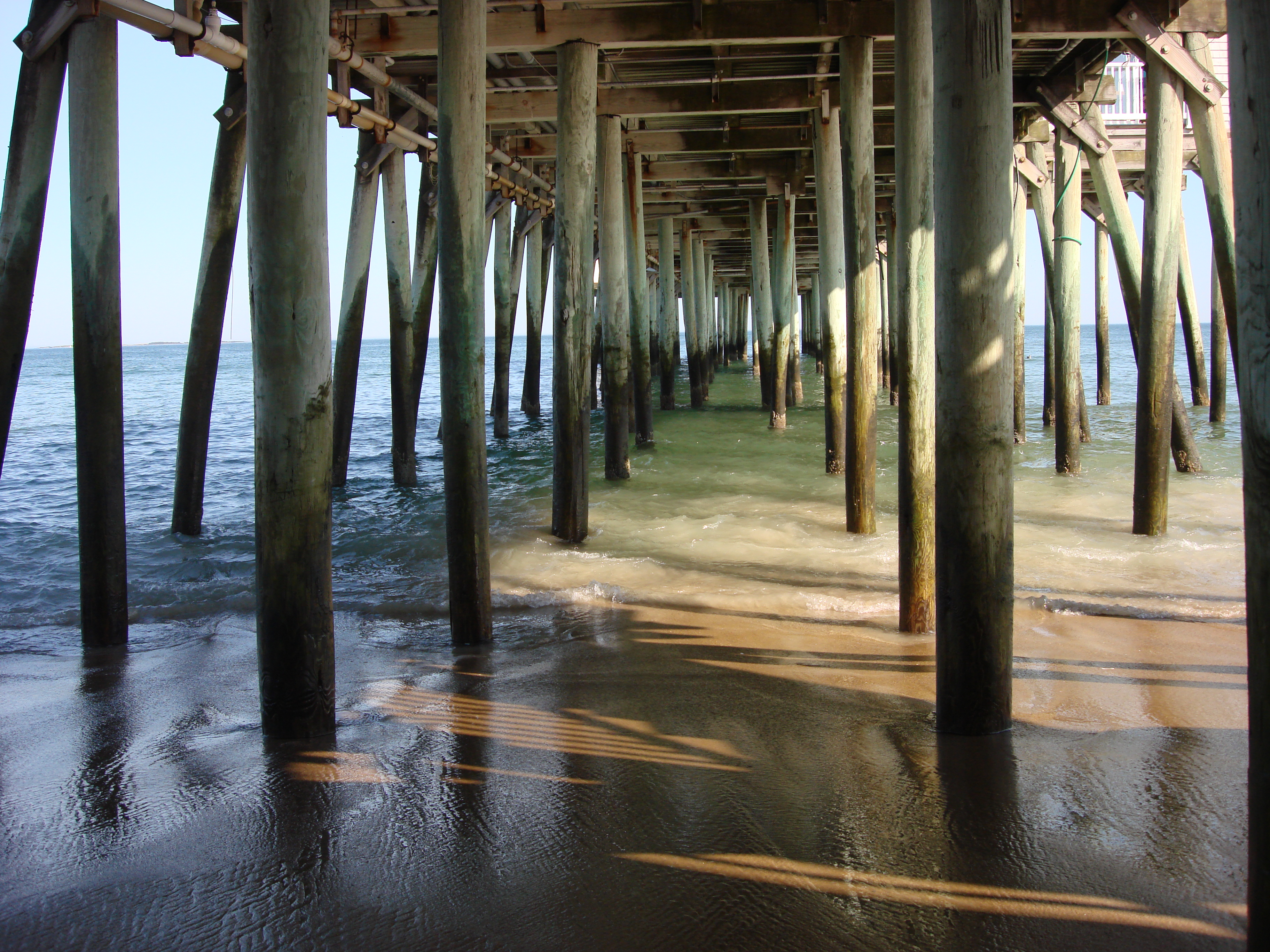
This is a short post but I just wanted to share one of my favorite places in New England–the pier at Old Orchard Beach in Maine.  The pier, or under the pier actually, is the perfect place to escape the sun and the crowd and to sit back and enjoy a good book and the sound of the ocean rolling in. Actually, I was so relaxed last time that my sandals washed out to sea and I had to chase after them like a fool.

The Darkness That Hides God

Last night I was laying in bed awake for hours because I drank a pumpkin latte about two minutes before bed after having a huge cup of coffee before that–fail.

While I was laying there, I started thinking about God and why I don’t like praying, or at least don’t like stopping and taking the time to pray. I love God, I want to know him better and be closer to him, so why is prayer so hard? All at once, I knew why it was so hard–because it feels like God isn’t there, it feels like I’m talking to myself or the walls, and it feels foolish to talk to oneself. I thought if God were sitting across the table from me sharing a cup of coffee and that were prayer, then I would pray a lot more–and I would pray much differently. Instead of asking for so much stuff (please do this, fix that, provide this) I would just ask questions after question. I would ask God why he is complicated and confusing to me and why the Bible can be so hard to understand. I would ask him a thousand questions and we would talk for hours. But God doesn’t sit across from me at the kitchen table and that is when it occurred to me that the darkest part of the fall was not sin but the fact that sin puts a veil of darkness between me and God. After all, before sin, God did sit across from us at the kitchen table so to speak–he walked with Adam and Eve in the garden in the cool of the evening and they talked and talked. Then sin entered in and darkness came between us and there is no walking with God in the garden anymore–of course God is with us and he hears our prayers but what a loss of closeness.

Someday that dark veil will be removed and we will walk with him again and I will ask all my questions whether they matter at that point or not. Until then, the dark veil remains and I must learn to pray in spite of that darkness–but I’ll pray differently now–I’ll pray with the hope that someday I will walk with God in the garden in the cool of the evening and there will be no darkness between us.