The Baby Leaves!

My husband always calls the first leaves of spring “baby leaves” because he gets a kick out of how tiny and bright they are. I decided to write a ditty about these baby leaves in honor of the first day of spring :] I hope you enjoy the baby leaves as they start to poke out in your part of the country!

The birds are singing and the peepers are peeping,

The buds are bursting with baby leaves and blooms.

The flowers are poking their heads through the sod

Ready to unveil the canvas painted all winter long.

The sky is competing with nature’s awakening hues

deepening ever in cobalt blue.

The windows are open, the breeze blows in–

The bugs think it’s an invitation to come in.

The ants are busy, busy as bees

but none are busy as the baby leaves.

A new generation, a grand debut!

The leaves work quickly, they must work fast–

by summer heat their lives are half past.

They delight in the spring with life anew,

Shade in the summer in rich emerald hue.

By autumn’s entrance they are golden and proud

blushing in crimson, pleasing the crowd.

They fall to ground robing it in color,

Sleep all winter getting ready for summer.

We wait and we watch until spring comes again–

until the baby leaves trust the sun’s warm rays

and burst forth with new life for a few short days.

Simplifying

A bird sings quietly in the trees outside my house. The sky is a vain shade of cobalt blue and without a cloud or sigh of winter. I have all this technology at my fingertips—a computer with high-speed internet, an IPod filled with my favorite music and apps, a TV with my favorite shows, a camera to take pictures, Facebook to share my life with family and friends…and yet a bird’s song outdoes them all. No song on my IPod is as lovely as that bird’s song, no picture I take with my camera can compare to the blue sky beauty just outside my window, no interaction on Facebook or text can compare to an interaction with nature—a walk in the woods, a swim in the ocean, or a gaze at the stars. Technology clutters my life; nature feeds my soul.

Henry David Thoreau was wiser 150 years ago than we are today. “Men have become the tools of their tools” (Walden p. 33), he said–and he said so before all the technology of today. What have we become? Technology serves its purpose, of course; I could not share these thoughts with you in this way were it not for computers and internet. But too often I lose my way and let my interactions with technology replace my interactions with God, man, and nature. Thoreau said, “I went to the woods because I wished to live deliberately, to front only the essential facts of life, and to see if I could not learn what it had to teach, and not, when I came to die, discover that I had not lived” (Walden p. 74). What could I learn about God, myself, and the people around me if I were to wake up from the stupor of technology and live deliberately?

de•lib•er•ate (adv., de•lib’er•ate•ly)

v. 1.To consider carefully and at length. 2. To take counsel together so as to reach a decision. 3. To think about or consider carefully; weigh. adj. 1. Carefully thought out; intentional. 2. Slow and cautious in determining or deciding. 3. Leisurely in movement or manner; unhurried; slow.

Syn. 1. Deliberate, ponder, reflect, meditate, and muse mean to think deeply, usually in silence (As defined by the Funk & Wagnalls Standard College Dictionary).

How much more could I enjoy this quiet little life I’ve been given were I to step out of the bonds of technology and into the sanctuary of nature—if I were to deliberate, ponder, reflect, meditate, and even muse upon the stunning beauty of the world around me? Today I read for the first time William Cullen Bryant’s A Forest Hymn–it is stunning. I would love to share the whole poem but it’s rather long so I omitted lines here and there:

“The groves were God’s first temples. …

Amid the cool and silence, he knelt down,

And offered to the Mightiest solemn thanks

And supplication. …

Ah, why

Should we, in the world’s riper years, neglect God’s ancient sanctuaries, and adore

Only among the crowd, and under roofs

That our frail hands have raised? Let me, at least,

Here, in the shallow of this aged wood,

Offer one hymn …

Father, thy hand

Hath reared these venerable columns, thou

Didst weave this verdant roof. Thou didst look down

Upon the naked earth, and, forthwith, rose

All these fair ranks of trees. They, in thy sun,

Budded, and shook their green leaves in thy breeze,

And shot toward heaven.

till, at last, they stood,

As now they stand, massy, and tall, and dark,

Fit shrine for humble worshipper to hold

Communion with his Maker. These dim vaults,

These winding aisles, of human pomp or pride

Report not. No fantastic carving show

The boast of our vain race to change the form

Of thy fair works. But thou art here—thou fill’st

The solitude. Thou art in the soft winds

That run along the summit of these trees

In music; thou art in the cooler breath

That from the inmost darkness of the place

Comes, scarcely felt; the barky trunks, the ground,

The fresh moist ground, are all instinct with thee.

Here is continual worship;—Nature, here,

In the tranquility that thou dost love,

Enjoys the presence. Noiselessly

Thou hast not left

Thyself without a witness, in the shades,

Of thy perfections. Grandeur, strength, and grace

Are here to speak of thee.

My heart is awed within when I think

Of the great miracle that goes on,

In silence, round me—the perpetual work

Of thy creation, finished, yet renewed

Forever. Written on thy works I read

The lesson of thy own eternity.

let us [not] need the wrath

Of the mad unchained elements to teach

Who rules them. Be it ours to meditate,

In these calm shades, thy milder majesty,

And to the beautiful order of thy works

Learn to conform the order of our lives.”

How stunning would it be to step away from our loud, busy worlds and see creation the way Bryant did? Get me to the woods.

Hampton Beach in the Spring

The weather here in Massachusetts has been wonderful all winter. The temperatures have been up in the 30s and 40s almost every day and we’ve had hardly any snow–this makes me smile–like this ———-> :]

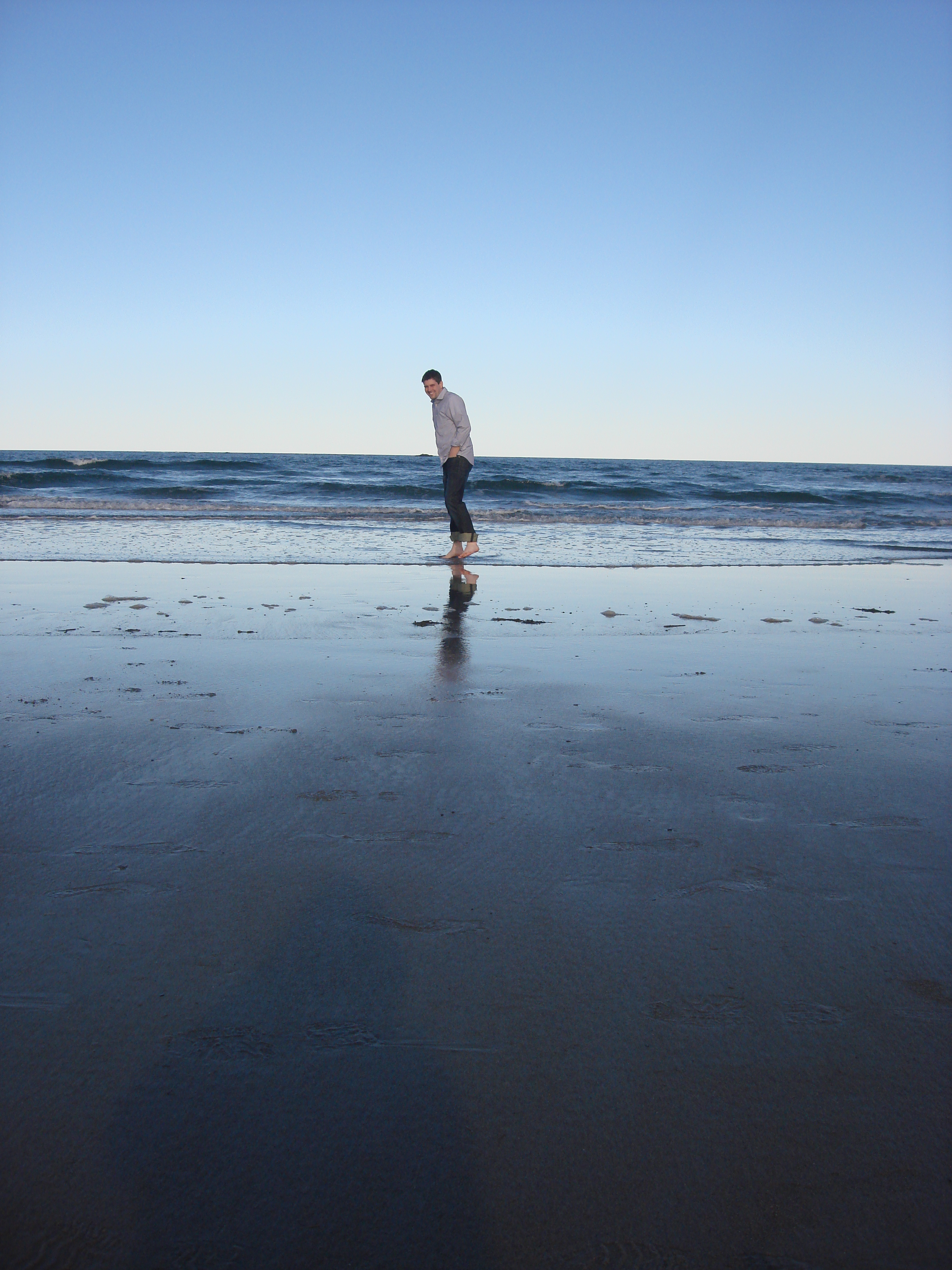
The only problem with the spring-like weather is that my brain actually thinks it is spring and it’s everything I can do to keep from throwing lunch in a basket and taking off for the beach. Last winter after we had been buried in snow for months, Darren I and decided we had enough and took off for the beach even though it was still freezing out and we weren’t yet out of winter. We went to Hampton Beach in New Hampshire before the beach was really open and had the whole expanse of ocean frontage to our cold crazy selves. Here’s a few pictures of Darren first taking off for the water, touching it and realizing just how cold it really was, then running back with a big grin on his face. I love his expression when he’s coming back from the water–he looks like a little kid all lit up by the excitement of a day at the beach :]

Who says the ocean is just for the warm weather days?

How to Be a Tree Hugger

When I was a girl I was always up a tree. The farm I grew up on spread out flat like a canvas dotted with so many different kinds of trees–apple, cherry, hedgewood, redbud, oak, juniper–it made no difference, I climbed them all.

We had a little orchard with apple, pear, cherry, peach, and plum trees. You do not know when you’re little what a privilege it is to walk out to the yard and pluck fresh fruit off a tree–local, organic, free–but the fruit meant nothing to me; it was the branches I cared about. We had an unusually large apple tree–the largest I’ve ever seen and I was fairly well persuaded as a child that it was planted right in that spot by Mr. Jonny Appleseed himself. The base of the tree was short and stout with a landing between two large branches that y’d out from the base. It was just the right height for little ole me to pull myself onto the landing and climb from there up the larger branches as high I could go before the skinnier and skinnier branches could no longer support my weight. The silver branches weaved together like a tapestry and formed a canopy overhead that guarded from the heat of the blazing sun and the cool drops of rain. I remember one year when the snow had already come and the apples were lush and red on that tree and my dad wanted to get the fruit in before it was all spoiled by the snow. I remember him climbing up into the tangled branches and dropping apples into my hands below.  I remember how cold it was in the wet snow. I remember after I had stayed for a while and all my brothers had gone back to the house, how my dad promised to pay me a dollar for staying with him and finishing the job. I remember caring nothing about the dollar–the comical sight of my dad all tangled like a cartoon character among the unruly branches that seemed to intentionally hold the fruit at arm’s length, just out of reach, was payment enough for me :] Many an hour I spent in and under that tree as a grew up on the prairie dreaming of bigger, better far away places…I have moved far from there now and have discovered no place better than the unsurpassable quiet found among the branches of that fat old apple tree.

We had a juniper tree tall, thin, and magnificent dotted with little blueish berries. I built a fort below it and climbed up its sticky, sap covered branches to look out for intruders and to watch the sunsets sweep across the sky in vain shades of pink and orange.

Across the yard, through the field, down into the woods, over the little bridge crossing the pond to the hedgewood tree I would march with my brothers. Here we built a fort together–and fought over its particular branches and landings from sunrise to sunset. Hedgewoods are not friendly trees; they are, with their thorny branches and rough bark, trees to be reckoned with and conquered. Their large green hedge apples filled with sticky glue were our weapons of choice when fighting for or defending the trees from which they came. The bright yellow wood hidden beneath the unassuming brown bark was too beautiful to burn and it always upset me when my dad insisted it burnt the longest and hottest and must be used for that purpose. I love fireplaces; I hate burning trees–they are simply too beautiful to burn.

We had three pine trees all standing in a row and in one of them we nailed a board here and there among the branches to sit on. I would climb up in that tree, find a cozy spot to lean back against the barky spine, open a book and there sit and read away the summer days until the sun finally gave out and settled behind the veil of the night sky.

Down through the fields, over the barbwire fence separating the neighbor’s land from our own, tip toe among the fat smelly black cows that so frightened me, and quick up into the tree with the enormous branch that grew straight out, stretching from the neighbor’s field across to our own. The neighbor’s were friends and did not care that I climbed their trees too. Here in the woods among the fat smelly black cows was my hideaway. Here the trees sat close together and the branches held hands overhead and the sun peeked through only in fleeting rays creating lacy sunshine patterns on the ground. Here the cows had trodden the grass into the dirt and left bare paths winding like a treasure map through the woods. Here I sat and grew up bit by bit, thinking the thoughts and feeling the feelings that have made me who I am today.

Last night a lay in bed thinking about the woods and the trees and the vast prairies spreading out endlessly before me. I thought about the smell of the country and the rustle of the wheat and corn rocking in the hot summer wind. I thought about the landscape of my childhood–vast and wild. I thought about the trees, the smell of the leaves, the feel of the bark and branches, the view from above–and missed it all terribly and realized what a terrible tree hugger I really am.

Missouri’s Quiet Lure

People here in New England often ask me why anyone would live in Missouri; that always makes me smile. They also ask me where Missouri is as they stare blankly trying to picture the United States map and the location of the (rather large, right in the dead center) state…somewhere…but where? Not that New Englanders aren’t smart enough to actually locate Missouri…it just escapes them due to its total lack of interest. The descriptions of Missouri that I have so far received from people who have never been there are as follows:

Flat, windy, tornado-ridden waste land that is hot and dry. Often mistaken with Kansas as if they are one entity. A place with no trees, water, or hills primarily housing cows and corn fields.

With this hellish vision in mind, can you blame them for blocking it out of their memory of the US map?

Like New England is stereotyped for its winters, Missouri is stereotyped for its nothingness. And like most stereotypes, it is wrong.

I suppose much of what is listed in that rather bleak description of Missouri is factually correct—it is flat, windy, and tornado ridden—but that’s not all. It also embodies the Ozarks which are studded with mountains, rivers, and caves—not at all flat or dry. And some of the things people make sound so awful are my most loved memories.

I grew up on a 24 acre farm in what we like to call the middle of nowhere. Our driveway was a quarter of a mile long and winding from our yellow farmhouse  set in the middle of the fields to a gravel road leading to Higginsville and Lexington. Being situated between a gravel road and farm land provided a lot of dust. Dust. Dry feathery dirt. But without dust, there is no sunset, not one to revel in at least. I remember the sunsets in Missouri being nothing but epic. When you combine all that dust with heavy storm clouds, you get the brightest shades of pink and orange and the darkest violets and navies all mingling together with the fleeting sun in one last hurrah each night.

Like the dust, the endless corn fields too held a little bit of magic. The places where the tractor turned while seeding left perfect bare circles in the middle of all that tall corn. I would go out to the fields at night and lay on the dirt in one of those circles gazing up at the night sky so clear and bright you could pick out the star formations. I was lost in an ocean of corn and that little bare circle was my secret castle among the endless rolling Plains.

Next to our house was a field no one farmed that grew tall with prairie grass. I remember lying in that grass, watching it rock like the ocean’s waves all around me. It didn’t feel empty or desolate, just quiet and vast. William Cullen Bryant captures my thoughts in his own writings about the Midwest:

The Prairies

“These are the gardens of the Desert, these

The unshorn fields, boundless and beautiful,

For which the speech of England has no name—

The Prairies. I behold them for the first,

And my heart swells, while the dilated sight

Takes in the encircling vastness. Lo! They stretch

In airy undulations, far away,

As if the Ocean, in his gentlest swell,

Stood still, with all his rounded billows fixed,

And motionless forever. Motionless?—

No—they are all unchanged again. The clouds

Sweep over with their shadows, and, beneath,

The surface rolls and fluctuates to the eye;

Dark hollows seem to glide along and chase

The sunny ridges. Breezes of the South!…”

I keep this poem on the bookshelf in my living room because it calls my heart back home and reminds me of those quiet days when I all I had to do was lay in the grassy field and watch the clouds go by.

All these thoughts about Missouri were stirred up when I saw a picture my mom posted on Facebook of the Katy Trail in Rocheport, Missouri. How many miles have I walked and ridden on this trail! The Katy Trail is a 237 mile railroad track that was covered over with crushed limestone and converted into a walking/biking trail. I had all but forgotten about this trail until I saw my mom’s picture of that familiar tunnel. Now my legs are aching for a long jog down this forgotten path.

Every place has its lure; you just have to go there and find it. Check out the link below for more information on the Katy Trail:

Bike the Katy Trail

Salisbury Beach

Salisbury, Massachusetts

The sun is proud and intense drenching us in its hottest summer rays.

I love the way the water changes colors as it rolls to land—morphing from navy blue in the depths, to green in the rising waves, to the purest white sea-foam as it comes crashing to shore, and finally, brown as it mingles with the sand and is drawn back out to sea.

The waves hollow out pockets in the sand that fill with bubbling water and catch your unsuspecting feet in their grasp. The shallow water pulling over these pockets stirs the sand, causing it to rise in wispy billows like dark storm clouds beneath the waves.

Sometimes I wonder how I could have grown up so far from the ocean (in Missouri, a land-locked state). And then I watch the waves as they billow and roll and somehow it reminds me of home and the vast, sweeping Plains. The waves swell and sigh like the corn and wheat rocking and bowing to the wind and two places so different somehow seem so much the same—vast, boundless, and loud with their silence.

Walden Pond

Concord, Massachusetts

Walden Pond

Even the birds are quiet in this quiet place; they sing below their breath, in a whisper, as if showing respect for the beauty of quiet. The wind rustles through the woods, across the water making the trees sigh and yawn with the motion—that is all, the rest is silence. The wind is cold but the trees flirt, taunting the warm air to come—blushing crimson in buds ready to bloom.

Misquamicut Beach

Westerly, Rhode Island

The ocean rumbles, crashes, swirls, and spins. The waves lap, roll, build until they smash against the shore. This is a place of constant motion, constant churning sound—and yet it is quiet, peaceful. The ocean with its billowing waves sings a lullaby of rest. It breathes it briny breath and kisses my face with saltwater kisses. A tiny bird hops and frolics on the beach in the shadow of the violent crushing waves. A ladybug works on her tan. The water rolls in undulating, ever-changing shades of green then brown before morphing against the sand into perfectly white sea foam.  The ocean is timeless and yet never the same.

Hampton Beach

Hampton, New Hampshire

The dark, water-laden clouds billow above taunting with stray drops of rain. The wind is strong, violent, driving and throwing the sea. The temperature is perfect; the beach is our own. The sky and the sea are the same threatening shade of blue-gray, tossing and reflecting off each other as they make the tempestuous transition into spring.